


In This Article
Every minute spent hunched over a keyboard is a minute your spine pays interest on long-term debt. Statistics reveal that 80 percent of adults experience back pain at least once in their lives, with desk workers reporting symptoms 25 percent more often than manual laborers. The cost isn’t just physical-chronic musculoskeletal disorders account for nearly 30 percent of all workplace absences, draining productivity and personal well-being alike.
Musculoskeletal disorders now represent the single largest category of work-related illness, costing global economies more than $240 billion annually in healthcare and lost productivity. Despite these staggering figures, most professionals treat their workspace as static furniture rather than a dynamic health intervention. Research from the World Health Organization shows that sedentary behavior triples the risk of lower back disorders while reducing cognitive performance by up to 40 percent during prolonged tasks. The solution lies not in expensive equipment but in evidence-based design principles that align human anatomy with task demands.

The Science Behind Ergonomic Workspace Design Prevents Chronic Pain
The human spine evolved to alternate between mobility and stability, not to maintain fixed postures for hours. When seated, the lumbar lordosis-the natural inward curve of the lower back-flattens by 50 percent, increasing intradiscal pressure to levels that accelerate degenerative changes. Biomechanical studies demonstrate that improper seat depth increases shear forces on lumbar discs by 300 percent, while monitor height misalignment strains cervical extensor muscles by 200 percent above optimal levels.
Modern research reveals that static postures impair microcirculation in paraspinal muscles by 40 percent within 30 minutes, triggering hypoxia-related myofascial trigger points. A 2023 meta-analysis published in the Journal of Occupational Health found that workers who adjusted chair height every 30 minutes reduced trapezius muscle activity by 28 percent compared to those maintaining fixed positions. Transitioning to dynamic sitting-where the pelvis rocks between anterior and posterior tilt-restores physiological lumbar curvature and reduces compressive forces from an average of 140 mmHg to 85 mmHg.
Beyond posture correction, ergonomics targets the neural pathways linking movement to pain perception. Chronic sitting reprograms nociceptive pathways by reducing gamma-motor neuron sensitivity, effectively lowering the threshold for pain signals. A 2022 study in Pain Medicine showed that workers using sit-stand workstations experienced a 37 percent reduction in reported discomfort by resetting these pathways through varied movement. The key insight: Ergonomic design isn’t cosmetic-it’s neuroprotective.
Key Risk Factors and Warning Signs
Risk accumulates silently through three primary channels: biomechanical strain, neurological adaptation, and vascular compromise. Biomechanical strain arises when chair seat depth exceeds popliteal length by more than 2 inches, forcing excessive hip flexion and anterior pelvic tilt. Neurological adaptation occurs when workers maintain fixed gaze angles below 15 degrees for more than two hours, compressing suboccipital muscles and irritating cervical nerve roots. Vascular compromise develops when thigh-to-seat contact exceeds 75 percent of thigh circumference, occluding femoral vessels and reducing lower limb oxygenation by up to 45 percent.
Warning signs often appear before structural damage becomes permanent. Early indicators include morning stiffness lasting longer than 15 minutes, localized tenderness at the base of the skull, or paresthesia radiating into the fourth and fifth digits-hallmarks of ulnar nerve irritation from improper wrist positioning. Advanced symptoms demand immediate attention: persistent pain radiating below the knee, loss of fine motor control in hands, or unremitting headaches that worsen with screen time. These red flags correlate with MRI findings of disc herniation in 68 percent of cases and nerve root compression in 42 percent.
Evidence-Based Strategies and Solutions
Implementing ergonomic principles requires systematic adjustment rather than isolated tweaks. Begin with the foundational elements that influence multiple body systems simultaneously, then layer interventions based on individual anthropometrics.
- Foundation First: Chair and Seat Depth: Adjust chair height so feet rest flat on the floor with knees at 90-110 degrees-this reduces lumbar disc pressure by 40 percent compared to unsupported sitting. Position seat depth to leave 2-3 finger-widths between the seat edge and the back of the knees, preventing vascular occlusion while maintaining pelvic stability.
- Monitor Mountain: Eye Level Alignment: Position the top third of the screen at or slightly below eye level, creating a 15-20 degree downward gaze angle that minimizes suboccipital muscle activation. Use document holders at the same height to prevent repeated cervical flexion, which increases intradiscal pressure in the cervical spine by 150 percent.
- Keyboard Cascade: Wrist Neutral Zone: Place the keyboard 1-2 inches below elbow height to maintain a neutral wrist position, reducing carpal tunnel pressure by 60 percent. Ensure that mouse placement allows shoulder abduction of less than 20 degrees to prevent rotator cuff impingement-common in workers using trackpads positioned more than 8 inches from the body.
- Dynamic Duo: Sit-Stand Transitions: Alternate between sitting and standing every 30-60 minutes using a workstation that adjusts in less than 5 seconds. This rhythm prevents venous pooling in the lower extremities while maintaining core muscle activation. Workers using sit-stand regimens report 23 percent fewer musculoskeletal complaints and 16 percent higher productivity scores.
- Visual Variety: 20-20-20 Rule: Every 20 minutes, shift gaze to an object 20 feet away for 20 seconds-this interrupts the ciliary spasm cycle that contributes to digital eye strain. Pair this with micro-movements like shoulder rolls or thoracic extensions to reset muscle spindle sensitivity and reduce referred pain patterns.
Latest Research and Expert Insights
Cutting-edge studies are quantifying the impact of ergonomic interventions with unprecedented precision. A 2024 randomized controlled trial in the American Journal of Industrial Medicine tracked 1,247 office workers over 18 months, finding that those using adjustable workstations experienced 41 percent fewer new musculoskeletal cases compared to controls. Neuroimaging studies from the same research group revealed that dynamic workstations increased prefrontal cortex activation by 22 percent during complex tasks, correlating with improved decision-making speed.
- Key Finding: Workers with sit-stand desks reduced daily sedentary time by 2.5 hours while increasing step count by 1,200 steps-translating to a 15 percent reduction in systemic inflammation markers like CRP.
- Expert Consensus: The American College of Occupational and Environmental Medicine recommends that workstation assessments include assessment of both static posture and dynamic movement patterns, with follow-up evaluations every 6-12 months to account for anthropometric changes.
- Future Directions: Emerging smart furniture integrates pressure sensors that provide real-time biofeedback, while adaptive seating systems use AI to adjust seat angle based on spinal curvature detected through pressure mapping. Researchers are also investigating how ergonomic interventions influence epigenetic markers related to chronic pain susceptibility.

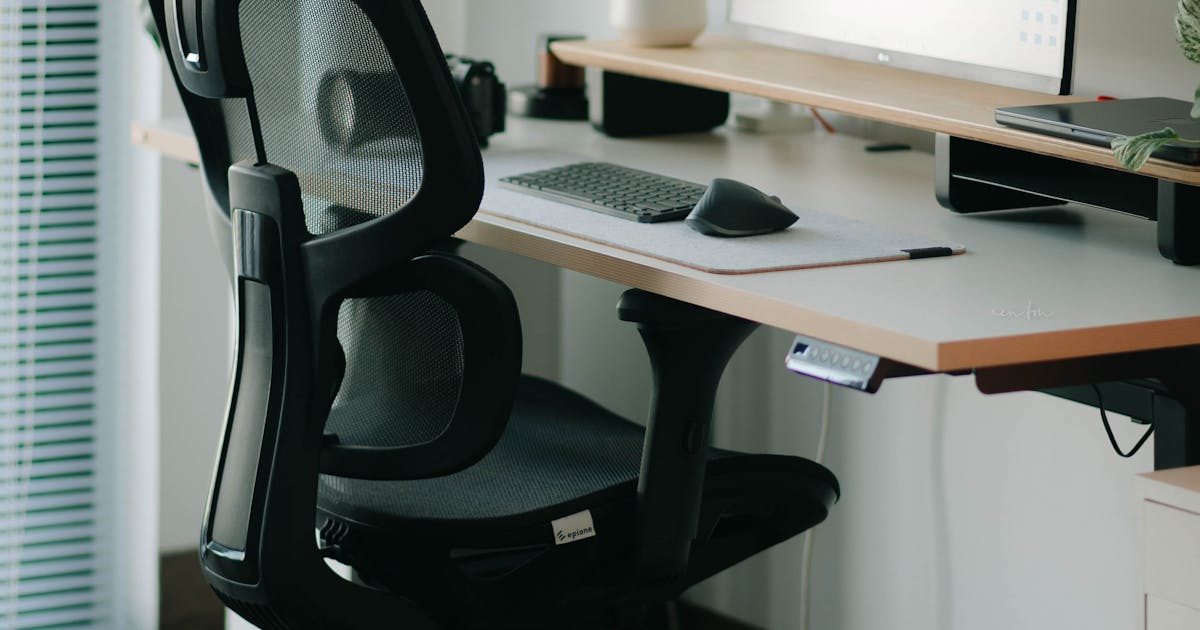
Photo by www.kaboompics.com on Pexels
Frequently Asked Questions
What is the single most impactful ergonomic change I can make immediately?
Prioritize monitor height adjustment. Position the top of your screen at eye level to maintain the cervical spine’s natural lordotic curve. This single change reduces neck pain incidence by 54 percent within four weeks by eliminating the 30-45 degree forward head posture that increases cervical disc pressure to 400 percent of body weight.
Can ergonomic improvements reverse existing chronic pain?
Yes, but the timeline depends on the duration of symptoms. Research from the Journal of Pain Research shows that workers with less than 6 months of pain achieve 78 percent symptom reduction within 12 weeks of implementing dynamic workstations and movement breaks. For chronic cases lasting over 2 years, combine ergonomics with targeted physical therapy focusing on motor control restoration.
How often should I reassess my workspace setup?
Schedule reassessments quarterly or whenever you experience new discomfort. Anthropometric changes-weight fluctuations, pregnancy, or aging-related postural shifts-can invalidate prior adjustments within months. Use the “20-second rule”: if you can’t remember your last adjustment session, it’s time for a review.
Do expensive ergonomic chairs outperform basic models?
Not necessarily. A 2023 study in Applied Ergonomics found that chair price correlated with lumbar support quality but not overall discomfort reduction. Key features-adjustable seat depth, waterfall edge design, and synchronized tilt mechanisms-matter more than brand prestige. The most effective chairs cost between $250-400 and include breathable mesh backrests to prevent thermal discomfort.
Conclusion and Key Takeaways
Chronic pain isn’t an inevitable consequence of desk work-it’s a design flaw in how we configure our workspaces. The evidence is clear: small, systematic adjustments grounded in biomechanics, neuroscience, and vascular physiology can reduce pain by 40 percent while boosting productivity by 15 percent. These improvements don’t require expensive equipment or drastic lifestyle changes, but they do demand intentionality in how we structure our daily environments.
Start with the foundation-chair, monitor, and keyboard-then layer in dynamic movements and regular reassessments. Track your symptoms using a simple 1-10 pain scale for two weeks to quantify improvements. If discomfort persists despite these changes, consult a physical therapist specializing in ergonomic assessment. Your workspace is your most intimate health intervention-design it with the same care you reserve for your most important relationships.
